Although technology is developing at a fast rate, there are lots of companies that still operate using software that was created 30 years ago. Even though these outdated systems can do their basic work, they probably do not possess the required capabilities that modern companies need.
With the advancement of cloud computing, AI, automation, cybersecurity, and digital communication, so-called outdated systems are not only an IT problem any longer—they also pose a risk for businesses.
Here, legacy system modernization comes as an important tool.
Modernizing groups of the current systems allows companies to upgrade their applications and get more efficient solutions while keeping their legacy systems.
Whether you are managing a manufacturing company, a healthcare company, a logistics business, a financial institution, or a SaaS company, it is crucial for you to know about legacy application modernization if you want to be competitive in your niche.
In this effective guide, we will give detailed information about legacy system modernization, including the main signs of the need for modernization, approaches to modernization, business benefits of modernization, main difficulties in modernization, and how to choose the right technology partner.
Learn about our custom software development services, which help companies modernize their old systems with future-oriented solutions.
What Is Legacy System Modernization?
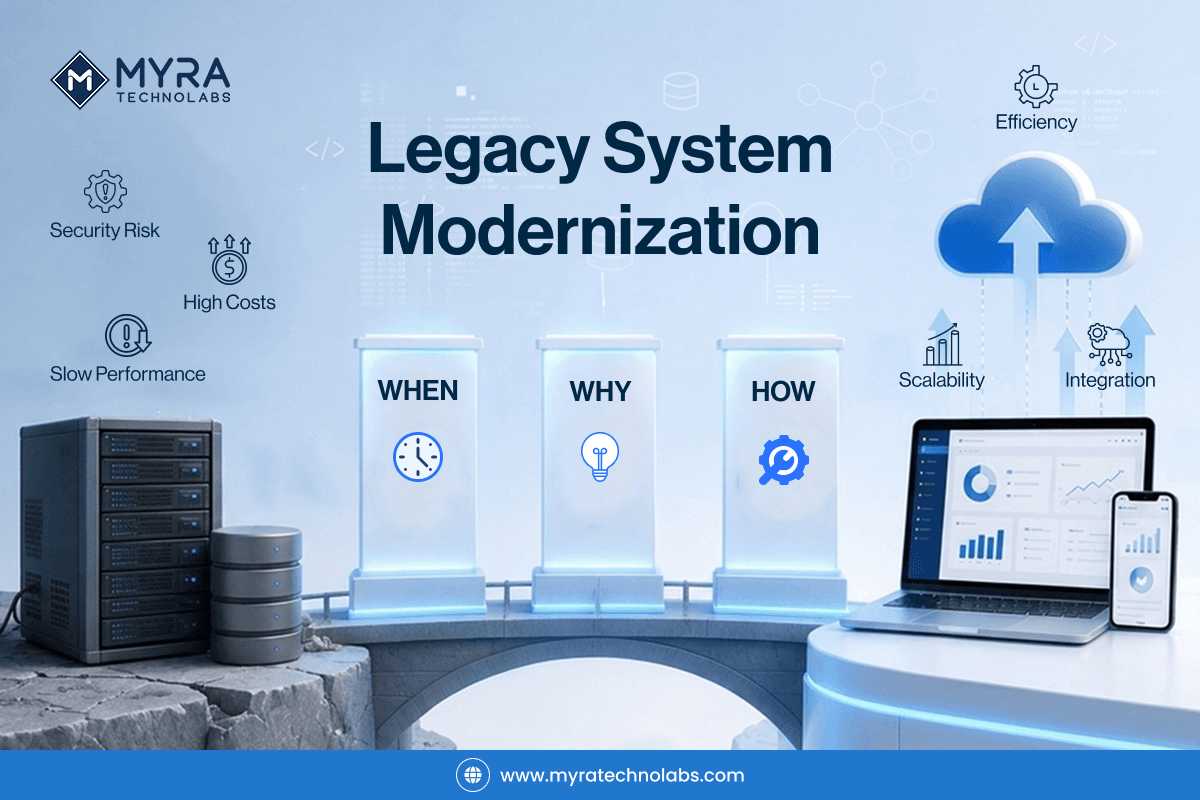
The process of Legacy System Modernization involves upgrading or transforming your existing systems to be able to serve current business requirements, allowing you to retain important business logic and historical data.
Unlike the total replacement of the software, modernization means improving already functioning systems without limitations that limit the future growth of the organization.
Some of the goals of the modernization process may include:
- Upgrading past technologies
- Raising application performance
- Moving to the cloud
- Strengthening security
- Allowing integration with modern applications
- Enhanced user experience
- Automation of manual processes
- Rebuilding specific parts of the solution
The companies opted for Application Modernization Services because changing critical software is a costly, risky, and disruptive endeavour.
Modernization has implemented a balanced approach that does not interrupt ongoing processes and allows for innovations.
What Is a Legacy System?
The term “legacy system” refers to technology, software, or hardware applications that are still in use but do not conform to more contemporary technological perspectives. Some legacy systems are:
- Desktop ERP systems
- Outdated CRM platforms
- Mainframe applications
- COBOL applications
- Legacy systems for accounting
- On-premise inventory systems
- Older manufacturing software
- Old custom applications created using outdated frameworks.
Even though these systems are still operational, they often introduce significant operational issues.
Is Your Legacy Software Slowing Business Growth?
Discover the hidden costs of outdated systems. Our experts can assess your current software and recommend the best modernization strategy for long-term growth.
Why Legacy Systems Were Successful
A lot of legacy software systems are created for various business processes over the years. Organizations have invested lots of money and time in the customization of these systems, which become part of the processes. As a result of this, legacy systems usually have:
- Years of customer data
- Finances
- Business processes
- Business policies
- Compliance systems
Because of this situation, it is not easy to get rid of legacy systems. Instead, many organizations prefer to apply Legacy Software Modernization instead of replacing it.
Why Businesses Continue Using Legacy Systems
Among the most common misconceptions is that companies persist in using old-fashioned software simply because they don’t want to change.
In fact, the decision is made for legitimate business reasons.
1. High Replacement Costs
Implementing brand new enterprise software can reach tens or hundreds of thousands of dollars.
For companies, Legacy Software Modernization presents an economical solution in many cases.
2. Business-Critical Operations
In business organizations, existing systems allow for supporting crucial processes, such as:
- Payroll
- Customer relations
- Manufacturing
- Inventory control
- Compliance
- Financial reporting
Any disruption leads to serious problems in operations.
3. Complex Business Logic
Many old systems come with many years of customized processes designed for the organization in question.
Achieving the same process from the ground up takes time and resources.
4. Employee Familiarity
Employees have spent a lot of time learning the current systems.
Moving to completely new software involves a lot of training and managing change.
5. Regulatory Requirements
Companies in such fields as healthcare, finance, insurance, and public services operate under very strict regulations.
Therefore, companies are not willing to change the systems that have already passed compliance verification.
Why Legacy Systems Become a Business Risk
Although legacy systems may persist in their functioning, they progressively become less economical and harder to maintain. Below are some of the main threats.
Increasing Maintenance Costs
Older software usually requires specific programmers who are becoming more difficult to locate.
Consequently:
- Costs of development increase
- Fixing bugs takes longer
- Vendor assistance disappears
- Maintenance consumes IT budgets
Rather than allocating money for innovations, companies spend funds only to support old systems.
Security Vulnerabilities
Cybercrime risks are changing daily.
Legacy software applications most of the time lack:
- Modern means of verification
- Data encryption
- Multi-factor authentication
- Safe APIs
- Zero Trust concept
Without frequent updates, legacy systems become the goal of cyber criminals.
Poor Integration Capabilities
Contemporary firms depend on numerous cloud applications.
Old software systems often cannot integrate with:
- CRM applications
- ERP systems
- Payment processing services
- Promotion automation tools
- AI-based analytic solutions
- Mobile solutions
This results in information isolation and ineffective procedures.
Limited Scalability
For a firm to grow, it needs to use appropriate technology.
Existing software systems are usually incapable of providing:
- More users
- Higher transaction levels
- Remote workplaces
- Cloud solutions
- AI-based automation
And this creates major Software Scalability Challenges.
Declining User Experience
Employees want effective, convenient software use.
The old design makes employees less productive and creates obstacles.
Typical problems are as follows:
- Low effectiveness
- Difficult orientation
- Manual inputs
- Bad compatibility with mobile devices
- Limited reporting options
The enhancement of user experience is the quickest way to increase productivity.
Future-Proof Your Business with Modern Software
Transform outdated applications into secure, scalable, and high-performing solutions that support business growth and digital transformation.
Top 10 Signs Your Legacy System Needs Modernization
To figure out whether or not it is the right time for your business to modernize, watch out for these red flags.
1. Rising Maintenance Costs
Most of the time, if the maintenance costs are rising rapidly, it is a sign that you have to re-examine Enterprise Application Modernization.
So, what warning signs should you look for?
- Frequent fixes of bugs
- High costs of licensing
- No more support from suppliers
- Difficulty with hiring developers
- Long downtimes of the business.
Expert advice: If maintenance takes more than 60% of your IT budget, then it is worth considering modernization as a strategic priority.
2. Frequent System Downtime
Unplanned downtimes influence:
- Clients’ satisfaction
- Employees’ work
- Things’ profitability
- Reputation of the brand
Good businesses need good technology, and updating the infrastructure enhances their operation greatly.
3. Security Risks Are Increasing
The previous systems were not made for the current world of cybersecurity.
Main threats include:
- Outdated OS
- Inefficient authentication
- Old encryption
- Conflicts with compliance
- Restrictions in monitoring
Application Modernization Services provide your company with better security and fewer compliance issues.
4. Your Legacy Software Can’t Integrate with Modern Applications
Modern companies are part of a big digital network. Your CRM, ERP, receipts, payments, customer service, and analytical tools have to communicate smoothly.
But many systems are outdated for the current API-driven market.
Yeah, if your employees are busy transferring data from one system to another or they need to pay for expensive middleware that can help them solve compatibility problems, it’s a sign that you have outdated technologies.
Common Integration Challenges
- Disconnected corporate applications
- Duplicate input of data
- Data inconsistencies
- Reports are being delayed
- The higher cost of operations
- The amount of automation is significantly limited
All these integration problems eliminate the chances of companies fully implementing Digital Transformation initiatives.
How Modernization Solves This Problem
A well-organized Legacy Software Migration allows a company to integrate its existing applications with up-to-date mobile services using API, microservices, and middleware.
Replacing all the systems is unnecessary for companies since they can update only important parts of their technology while keeping the older approach of doing business.
Learn how our Custom Software Development Services help to make the process of integration easier for various businesses.
5. Employees Depend on Manual Processes
One of the costliest implications of using antiquated software is the reliance on tedious manual labor.
Your staff will spend countless hours every week:
- Transferring information from one program to another
- Putting together reports manually
- Changing data in spreadsheets
- Processing bills
- Approving tasks via e-mail
- Cross-validating information about the client
These processes waste time and make wrong decisions possible.
Business Impact
The impact of manual work can be as follows:
- Inefficiency
- Delays in making decisions
- Poor customer service
- High costs
- Bored and angry employees.
That’s why modern companies are investing in the Business Process Modernization process in order to solve these problems.
Expert Insight
Automating processes is not intended to take away jobs but to facilitate the performance of valuable assignments.
Ready to Modernize Your Legacy Applications?
Reduce maintenance costs, improve security, and boost operational efficiency with a tailored modernization roadmap built around your business goals.
6. Your Software Provides Poor User Experience
The experience of the personnel influences their productivity.
Therefore, complicated software that requires several consecutive actions to carry out simple tasks as well as not being mobile can lead to reduced efficiency.
Here are the most common issues:
- Low loading speed
- Old-fashioned design
- Complicated navigation
- Poor search capabilities
- Limited availability
- No mobile version
Why UX Matters
Researchers show that easy-to-use systems lead to:
- Higher employee satisfaction
- Faster performance of tasks
- Better customer service
- More effective training
With Legacy Applications Modernization, companies often recreate the user interface using the pre-existing business processes.
Learn more about our UI/UX Design Services, providing an intuitive experience for users.
7. Your Business Can’t Scale Efficiently
Every business seeks to grow in some form. However, the advent of outdated technology can stifle growth. As demand from customers increases, so do the demands of legacy technologies such as:
- Increasing transaction amounts
- Growing number of users
- Emerging business locations
- Telecommuting requirements
- Mobile capabilities
- Cloud connectivity
Legacy technology poses software scalability challenges to growing companies.
Signs of Scalability Problems
- Slow application response
- Database traffic jams
- Regular crashes
- Long processing periods
- Issues related to infrastructure
Why It Matters
Technology should be a supporting tool for growth.
New software architecture allows companies to expand their operations without compromising performance.
8. Regulatory Compliance Has Become Difficult
Regulatory compliance continues to change in verticals.
Sectors such as healthcare, finance, insurance, logistics, and government have strict requirements connected to cybersecurity and data privacy.
Legacy applications often do not support new regulations, such as:
- GDPR
- PCI DSS
- HIPAA
- SOC 2
- ISO 27001
- Inability to meet compliance requirements may lead to:
- Legal proceedings
- Financial penalties
- Breakdown in customer trust
- Operational disruption
That is one of the major reasons why businesses are pushing for Enterprise Application Modernization.
9. Innovation Has Slowed Down
Is your company able to launch new features promptly?
Is it possible for your company to implement AI technology?
Is it viable to use automation in your processes?
Is it possible for your company to leverage cloud technologies?
No or yes for any of these questions? Your existing software is likely blocking your way to innovation.
Today, customer expectations are changing rapidly, so businesses need to evolve.
With older systems, innovation gets slowed down due to longer development cycles.
The latest generation of software gives businesses the chance to:
- Launch new services faster than ever before;
- Provide better client experience;
- Integrate new technologies;
- Achieve constant improvements.
10. Your Competitors Are Moving Faster Than You
Technology is now among the biggest competitive advantages for companies.
The companies that implement Legacy System Modernization can count on:
- Quick decisions made
- Enhanced customer experience
- Increased efficiency
- Decreased maintenance
- Larger advantage over competitors
In contrast, companies utilizing outdated systems are having complications with modernization.
It is not a question of whether modernization is needed anymore; it is a question of whether the company can afford to wait.
Build Smarter Software for Tomorrow’s Business
Our team develops scalable, cloud-ready, and secure software solutions designed to support innovation, productivity, and long-term success.
Why Legacy System Modernization Is Critical in 2026
Many business changes are seen today.
Customers are looking for digital environments that are flawless.
Employees want to work in flexible conditions.
Executives expect instant information.
Cyberattacks are evolving constantly.
AI is changing industries at a fast pace.
Those who still use obsolete technologies are being left behind.
Main business drivers
- Digital transformation
- Cloud computing
- AI implementation
- Business process automation
- Cyber-security
- User experience
- Efficiency of work
- Competitiveness of companies
Modernization is now a business strategy and not just an IT project.
Benefits of Legacy System Modernization
Companies that engage in Legacy Software Modernization usually see benefits in terms of their operational metrics.
Improved Security
Modern technologies include:
- Two-factor authentication
- Sophisticated encryption techniques
- Safe application programming interfaces
- Constant monitoring
- Access according to different roles.
As a result, companies’ cybersecurity is enhanced.
Better Performance
Upgraded software is characterized by speed and efficiency.
Some benefits are:
- Speed up work processes
- Minimize downtime
- Increase quality of applications
- Enhance customer satisfaction.
Lower Operational Costs
Even though modernization involves certain investments, it results in long-term cost savings, since:
- Maintenance is eliminated
- Manual operations are scaled down
- Further infrastructure costs are reduced
- Productivity is increased.
Enhanced Scalability
Modern-day architectures have made it simpler to:
- Introduce additional users
- Expand internationally
- Support remote teams
- Offer new products
Improved Customer Experience
Modern technology allows companies to deliver:
- Faster service
- Customized services
- Self-service options
- Mobile access
It is not the customers who need to change their minds in order to get interested in a company anymore.
Greater Business Agility
Companies that use new technologies can respond faster to the requirements of the market. They do not have to wait for months to receive the updates anymore and can improve their services all the time.
Upgrade Legacy Systems Without Business Disruption
Modernize critical applications while protecting your business data, minimizing downtime, and ensuring a smooth digital transformation journey.
Legacy System Modernization vs. Complete System Replacement
| Factor | Legacy System Modernization | Complete Replacement |
| Risk | Lower | Higher |
| Cost | Moderate | High |
| Business Disruption | Minimal | Significant |
| Timeline | Faster | Longer |
| ROI | Faster | Long-Term |
| Employee Training | Limited | Extensive |
| Existing Data | Preserved | Migration Required |
When Modernization Is the Better Choice
Take the alternative of Legacy System Modernization if:
- Software helps with the functioning of the main organizational processes.
- The existing workflow is valuable for the business.
- You are looking to minimize costs and risks involved.
- You need quick implementation.
- You want to utilize modern technologies without doing a complete reconstruction of everything.
When Replacement Makes More Sense
Replacement might be the solution in the following cases:
- Software is unsupported anymore.
- You cannot upgrade the architecture.
- You are spending more on maintaining the software than on modernization.
- Business needs have changed significantly.
Understanding the 6Rs of Legacy System Modernization
The 6Rs strategy is one of the most commonly accepted strategies for Legacy System Modernization, which enables companies to choose the appropriate methodology for modernization.
Rehost – Move existing applications to a new platform with minimal or no effort.
Replatform – Make changes to existing applications to suit them for a modern platform yet keep the existing functionalities intact.
Refactor – Change existing application code in order to make it easily maintainable and more efficient.
Rearchitect – Change the architectural design of the application for better performance.
Rebuild – Create a new application using the same features of the previous software.
Replace – Start from scratch and utilize the alternative system in case it is impossible to modernize the existing one.
The choice of the most suitable methodology for your company depends on the goals, technical issues, budget as well as plans for further development.
Our Dedicated Software Development Team can assist you in evaluating your system and choosing the appropriate method for modernization.
Legacy System Modernization Strategies: Choosing the Right Approach
There is no universally applicable tech landscape across businesses. For instance, a manufacturing company with a 20-year-old ERP system will need to approach modernization differently compared to a health care organization dealing with patient records or a logistics organization overseeing thousands of shipments each day.
This is the reason for effective Legacy System Modernization to begin with the selection of an appropriate modernization strategy instead of merely containing the software changes.
This strategy should allow businesses to maximize their value and reduce disruptions, costs, and operational risks.
Below is a list of the most efficient modernization strategies used by firms across the globe.
Rehosting (Lift and Shift)
Most Suitable For: Firms that need to quickly switch to a cloud environment from an in-house operation.
Rehosting is the process of migrating an existing software system from the physical premises to the cloud with minimal changes to the source code or architecture.
Benefits
- Fastest migration
- Affordable migration
- Minimal impact on business operations
- Improved reliability of infrastructure
Flaws
- Existing software limitations continue to exist.
- Technical problems remain.
- The adoption process remains the same.
Best suited when: Your application functions well but requires some infrastructure improvements.
Replatforming
Ideal For: Companies looking for enhanced efficiency without huge redevelopment projects.
Replatforming involves updating the systems, databases, and runtime configurations in such a manner that core functionality of the application remains unchanged.
Examples include:
- Recent SQL Server upgrades
- Implementing the managed cloud database
- Moving to Kubernetes
- Containerizing applications
Advantages
- Better scalability
- Improved reliability
- Lower maintenance
- Cloud readiness
This method is among the most widely used Cloud Application Modernization approaches because it brings a lot of operational benefits without redeveloping the whole application.
Refactoring
Refactoring takes care of the internal programming of an application while keeping the actual interaction of users with it intact. It is similar to fixing the foundation of the building but avoiding replacing, or even changing, the appearance of something.
Some examples of common improvements are:
- Clearing technical debts
- Improving performance
- Simplifying the coding process
- Increasing security levels
- Making future maintenance easier
Advantages
- Smoother subsequent development
- Improved performance
- Fewer bugs
- Cheaper maintenance
Companies utilizing Application Modernization Services prefer to first refactor their applications before developing new features.
Rearchitecting
With the growth of companies inevitably comes a situation where the software architecture can become a bottleneck.
Rearchitecting helps organizations move away from standard monolithic applications to designs such as:
- Microservices
- Event-driven systems
- Serverless computing
- API-first architecture
Benefits
- Deployment independence
- Higher scalability
- Improved fault tolerance
- Faster feature release
- Ease of integration
This method is perfect for companies that aim for long-term Enterprise Application Modernization.
Rebuilding
At times, there are software systems in use that have great business logic, but the technology used is old.
Rather than changing the old code, businesses develop a totally new program based on modern frameworks yet with the same business logic.
Benefits
- Modern tech stack
- Better user experience
- Greater security
- Cloud-native architecture
- Sustained supportability
Rebuilding may have more investment than refactoring, but ultimately it will provide a better return in the longer run.
Replacement
In several situations, the modernization effort may not suffice.
Replacement becomes a better option when:
- Software support is no longer available.
- Technology is outdated.
- Business needs have changed significantly.
- Maintenance costs become higher than replacement costs.
Replacement projects involve migrating valuable business information and processes during Legacy Software Migration.
Modernize Legacy Systems with Confidence
Our experienced development team helps businesses migrate, integrate, and modernize applications using proven strategies and modern technologies.
Cloud Application Modernization: Why Cloud Is Driving Business Transformation
The appearance of cloud computing has radically affected how companies develop, install, and manage software without needing costly localized infrastructure, such as:
- More flexibility
- Lower infrastructure costs
- Automatic scalability
- Better disaster recovery
- More convenient collaboration
- Global availability
That is why Cloud Application Modernization is one of the greatest solutions for businesses that lack long-term growth opportunities.
Advantages
- Lower hardware costs.
- Faster software deployment.
- Efficient business continuity.
- Enhanced security and scalability.
Our Custom Software Development Services enable businesses to design applications that operate in cloud environments and provide further scalability and development possibilities.
How AI Is Transforming Legacy System Modernization
Not only is Artificial Intelligence a differentiation factor for organizations, but it is also becoming one of the essential aspects of software development.
Companies are now deploying AI technology to speed up the implementation of modernization projects and facilitate the decision-making process.
AI Use Cases
Intelligent Code Analysis
AI tools can process huge volumes of legacy code and detect the following:
- Bottlenecks in performance
- Security problems
- Code copying
- Technical liabilities
Automated Testing
Modern AI-based testing platforms can help with:
- Finding bugs in software
- Creating test scenarios
- Improving software quality
- Minimizing tests duration
Business Process Automation
Companies can automate routine processes such as:
- Invoice processing
- Handling customer inquiries
- Managing documents
- Approving workflows
- Data entry
This contributes to wider business process modernization projects.
Predictive Analytics
Modern software technologies rely on AI to:
- Foresee demand
- Predict equipment malfunctions
- Enhance customer satisfaction
- Manage stock levels
- Identify fraud
The above-mentioned tasks are impossible to perform with the use of outdated technologies.
Industries That Benefit Most from Legacy System Modernization
While all sectors can enjoy the advantages of modernization, certain sectors where high-tech products and technology are vital to operations receive a stronger return on investment.
Healthcare
In the healthcare industry, improving:
- EHR
- Patient portals
- Telehealth
- Appointment scheduling
- Compliance with regulations
The advantages are better patient care and safety, as well as improved efficiency.
Financial Services
Financial institutions work on modernizing such areas as:
- Digital banking
- Mobile payments
- Fraud detection
- Compliance with regulations
- Security of transactions
This allows faster innovation and fewer cyber threats.
Manufacturing
Manufacturers also often modernize systems to benefit from:
- IoT technology
- Production control
- Predictive maintenance
- Analytics in supply chain
- Automated inventory management
The result is reduced operational costs and improved efficiency.
Logistics & Transportation
Thanks to modernization, logistics companies can:
- Optimize routes
- Trace delivery
- Automate warehouse processes
- Improve fleet operation
- Speak to their customers better
Retail & E-commerce
Modernization also helps retailers with:
- Omnichannel selling
- Synchronization of stocks
- Personalized shopping experience
- AI recommendations
- Combined payment systems
Education
Educational institutions modernize software for:
- Student management
- E-learning courses
- Admission
- Communication
- Collaboration
Common Challenges During Legacy System Modernization
Modernization programs come with high returns on investment – but attaining these returns involves a process of planning and execution.
Below are some examples of challenges faced during a modernization project:
Data Migration Risks
- Migrating years of critical business data without any data loss requires careful planning.
Employee Resistance
- Users of legacy applications may not be very supportive of the change.
- Comprehensive training and communication have been shown to improve acceptance
Integration Complexity
- Linking legacy applications with new cloud solutions often requires tailor-made APIs and middleware.
Budget Constraints
- The evaluation of the modernization process should be based on the long-term ROI rather than the costs of implementation.
Security During Migration
- Ensuring that sensitive data is well protected during the entire process of modernization should be among the main priorities.
Expert Tip
Organizations often make the erroneous decision of trying to modernize every one of their applications at once.
The modernization should start off with the most critical business systems, and be carried out in manageable steps, which allow the firm to reduce its risks and start receiving tangible benefits more quickly.
Improve Performance with Modern Enterprise Software
Replace outdated processes with scalable software that enhances productivity, strengthens security, and supports sustainable business growth.
Legacy System Modernization Best Practices
Successful legacy system modernization is not just about upgrading technology. It needs to have a clear picture of how the modernization activities will coincide with the objectives of the organization while reducing operational risks. The following practices will ensure the success of the modernization initiative.
Assess Your Existing Technology Landscape
Here are the steps to undertake before updating your systems:
Evaluate the following:
- Business-critical applications
- Technical debt
- Infrastructure
- Cybersecurity vulnerabilities
- Software dependencies
- User adaptation
- Integration capabilities
These results will help you decide the type of application modernization that you may need.
Prioritize High-Impact Applications
Not every application will require immediate application modernization.
You may start with:
- Applications that generate revenue
- Applications that support customer operations
- Applications with high maintenance costs
- Applications with security concerns
- Applications that do not allow business scaling
Focusing on the right applications provides for fast ROI.
Define Clear Business Goals
Technology must facilitate measurable business results.
Examples include:
- Lowering operational costs by 30%
- Enhancing system reliability
- Raising labour efficiency
- Enhancing customer service
- Speeding up product delivery
- Increasing safety of information systems
Build a Phased Modernization Roadmap
Refrain from the urge to modernize all applications at once.
Instead, modernize step by step:
Phase 1
Evaluation
↓
Designing Plan
↓
Risk Assessment
↓
Reviewing Design
Phase 2
Pilot Program
↓
Trial
↓
Response from Users
↓
Optimizing Performance
Phase 3
Enterprise Launch
↓
Workforce Instruction
↓
Constant Oversight
↓
Continual Upgrades
Invest in Change Management
Technology by itself is not a recipe for success.
Successful modernization must also include:
- Employee communication
- Training of users
- Backing of managers
- Adoption strategies
- Being able to measure performance
Organizations that prepare their workforce for changes achieve a much better rate of success in implementing projects.
Legacy System Modernization Roadmap
Here is a straightforward plan that companies can implement.
| Stage | Objective |
| Assessment | Recognize business problems and technical debt |
| Planning | Select a modernization strategy |
| Architecture | Design future-state solution |
| Development | Revamp applications |
| Testing | Test functionality and security |
| Deployment | Commence operations smoothly |
| Optimization | Improve continuously and monitor performance. |
How to Measure the ROI of Legacy System Modernization
Modernization should provide evident business advantages.
The KPIs include:
Operational Efficiency
- Workflows become quicker
- Manual work becomes less
- Maintenance activities decrease
Cost Reduction
- Costs of maintaining infrastructure go down
- Maintenance-related expenses are lower
- Downtime is reduced
Business Agility
- Faster launches of new products
- Quicker introduction of new features
- Improved reaction to customers
Customer Experience
- Faster reply times
- Higher user satisfaction
- Better virtual experiences
Security
- Fewer weaknesses
- Better adherence to rules
- Lower risks of cyber attacks
Need Expert Guidance for Software Modernization?
Our specialists analyze your current systems, identify modernization opportunities, and recommend practical solutions that align with your goals.
Real Business Scenario
Picture a logistics firm with an outdated warehouse management system, which is 15 years old.
Before Modernization
The firm depends on
- Manual inventory updates
- Slow order fulfillment
- Lack of mobile access
- Frequent downtime
- Poor reporting
- Difficult integration.
Modernization Strategy
But then the firm opts for modernization to a
- Cloud environment
- API integration
- Mobile app
- Automated processes
- AI-driven reporting
- Modern dashboard
Results
And as a result:
- 45% faster order fulfillment
- 60% reduction of manual effort
- Improved customer satisfaction
- Reduced operational costs
- Increased visibility of business operations
The results may differ in practice; this is only one suggested case of success of the Legacy System Modernization process in improving effectiveness.
Why Choose Myra Technolabs for Legacy System Modernization?
Modernization projects need more than technology know-how; they need a partner with insight into business change. Myra Technolabs helps organizations modernize with solutions that minimize risk and deliver long-term benefits. Our areas of know-how are:
- Legacy Application Modernization
- Application Modernization Services
- Enterprise Software Development
- Custom Software Development Services
- Cloud Application Modernization
- Legacy Software Migration
- API Integration
- Business Process Automation
- Artificial Intelligence-Powered Software Solutions
- Software Consulting
At Myra Technolabs, we can create a flexible action plan that aligns modernization with your strategic priorities, whether it involves upgrading a single application or a whole technological environment.
If you would like to know more about our Custom Software Development services for business companies, you can visit our webpage and learn how to use our solutions for developing secure, scalable, modern applications for business. You can also check out our option to Hire Dedicated Developers in order to facilitate successful implementation of the modernization project.
Final Thoughts
In the field of technology, the emphasis should be placed on innovation rather than on restricting it.
Organizations facing increased maintenance expenditures, worries about security systems, bad integrations, or the threat of not scaling would benefit from making updates in their systems sooner rather than later.
The right strategy for legacy system modernization makes it possible to keep all the vital information while also incorporating new technologies in the form of cloud solutions, automation, artificial intelligence, and modern architecture.
Successful companies do not see this process as a cost; they view it as a strategic decision allowing the company to develop and adapt to continually transforming realities.
Utilizing the help of a full-time software development company makes modernization less risky.
Ready to Future-Proof Your Business?
Old systems need not limit the ability of the business to grow. Myra Technolabs can offer full assistance in the area of Legacy Software Migration, Cloud Application Modernization, or Enterprise Application Modernization. The experts at Myra Technolabs are able to develop strong software systems suitable for the company’s requirements.
Ready to Transform Your Legacy Systems?
Partner with Myra Technolabs to modernize outdated software, improve operational efficiency, and build secure, future-ready applications for long-term business success.